Reception and an upgrade
A construction tender for the wider upgrade was published in November 2026.
To be checked What is received and treated now, including the fate of trucked solids, and what the upgrade will change.
Septage in Barbados · working notes
What happens to the solid part of septage pumped from tanks in Barbados? We would like to understand, with haulers and operators, what happens to those solids after reception. We wondered whether a more traceable, careful route could protect water and perhaps put some material to use locally.
A question, still open ✦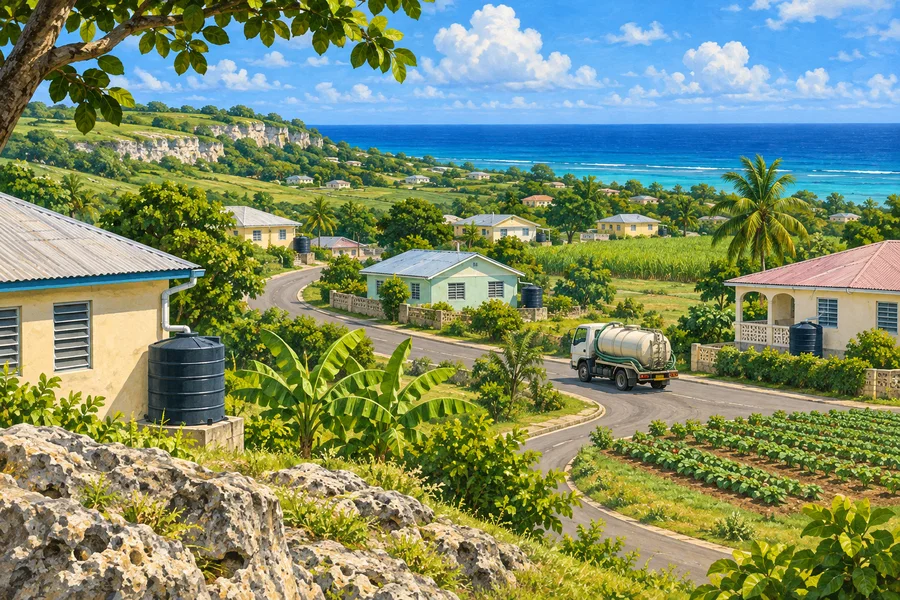
Protect water. Care for solids. Keep the work local.
Could a compact separation step fit within an existing service? We explored one possible method with Simon Moos. Whether it answers a need in Barbados is for Barbadian operators to help establish.
Only if health and chemical tests, local soils, users and rules allow it. An authorised fallback is needed too.
Its quality, capacity, cost and permitted treatment destination all need checking. Separation alone does not make it safe to release.
The next steps in the chain remain to be clarified.
A private truck pumps out septage.
Haulers know the actual routes and volumes.
The Barbados Water Authority (BWA) assessment lists a septage receiving unit.
How are they treated and where do they go?
Any useful step would have to fit what exists.
A construction tender for the wider upgrade was published in November 2026.
To be checked What is received and treated now, including the fate of trucked solids, and what the upgrade will change.
The revised assessment describes dewatering and drying sludge produced at that plant. It does not establish a separate intake for trucked septage.
To be checked Whether outside loads are in scope and what works are operating.
The programme calls for regulatory and operational improvements and one of its targets is stronger septage management. It does not specify our equipment or a contract.
To be checked How the BWA defines that target and what help, if any, it wants.
What our research actually covered.
We studied the island, the service, the rules and the practical costs. Open a note to see what we found and what still needs checking.
Groundwater, collection, public plans, rules and the people who know the route.
Documented: The 2020 Green Paper describes permeable limestone, groundwater protection zones and nitrate pressure from sanitation and agriculture. That made water protection our first test.
To be checked: The operative protection-zone maps and what conditions would apply to any specific site. No plot has been identified or agreed.
Reference: Bridgetown environmental assessment, table 1, PDF p. 15.
To explore together: We would like to learn from operators and haulers how reception works in practice: accepted and refused loads, hours, fees, volumes, and destinations after reception.
We also looked at SBRC and Mangrove Pond. Their existing composting and disposal activities do not establish an outlet for septage solids; that possibility would need to be discussed with them.
References: South Coast revised assessment, PDF pp. 34–37; World Bank programme systems report, PDF p. 12, target “Strengthened septage management” (DLR 4.3).
To be checked: Actual contract scopes and progress, future truck reception, compatibility of the separated liquid with planned treatment, and what, if anything, remains unserved. A published tender does not mean the new works are operating.
References: Green Paper, 2020, p. 22; BWA (Water Protection Zones) Order, S.I. 2024 No. 27, gazetted on 13 June 2024, paragraphs 4 and 5. This replaces the 2023 copy cited in our early notes.
To be checked locally: Application to individual properties, requirements for haulers, reception charges, discharge permissions and any Barbadian standard for treated septage solids.
The BWA runs the public plants. Health, the EPD and Planning hold different parts of the rules and permissions; private haulers know the collection routes. Farmers and solid-waste operators can speak to possible destinations. No single body controls the whole journey from tank to outlet.
To be checked: Which institutions now hold each decision, whether the Water and Wells Management Committee is active, and who would welcome an outside contribution. We would begin by listening to the people doing this work.
A method to test, its two outputs, and the question of place.
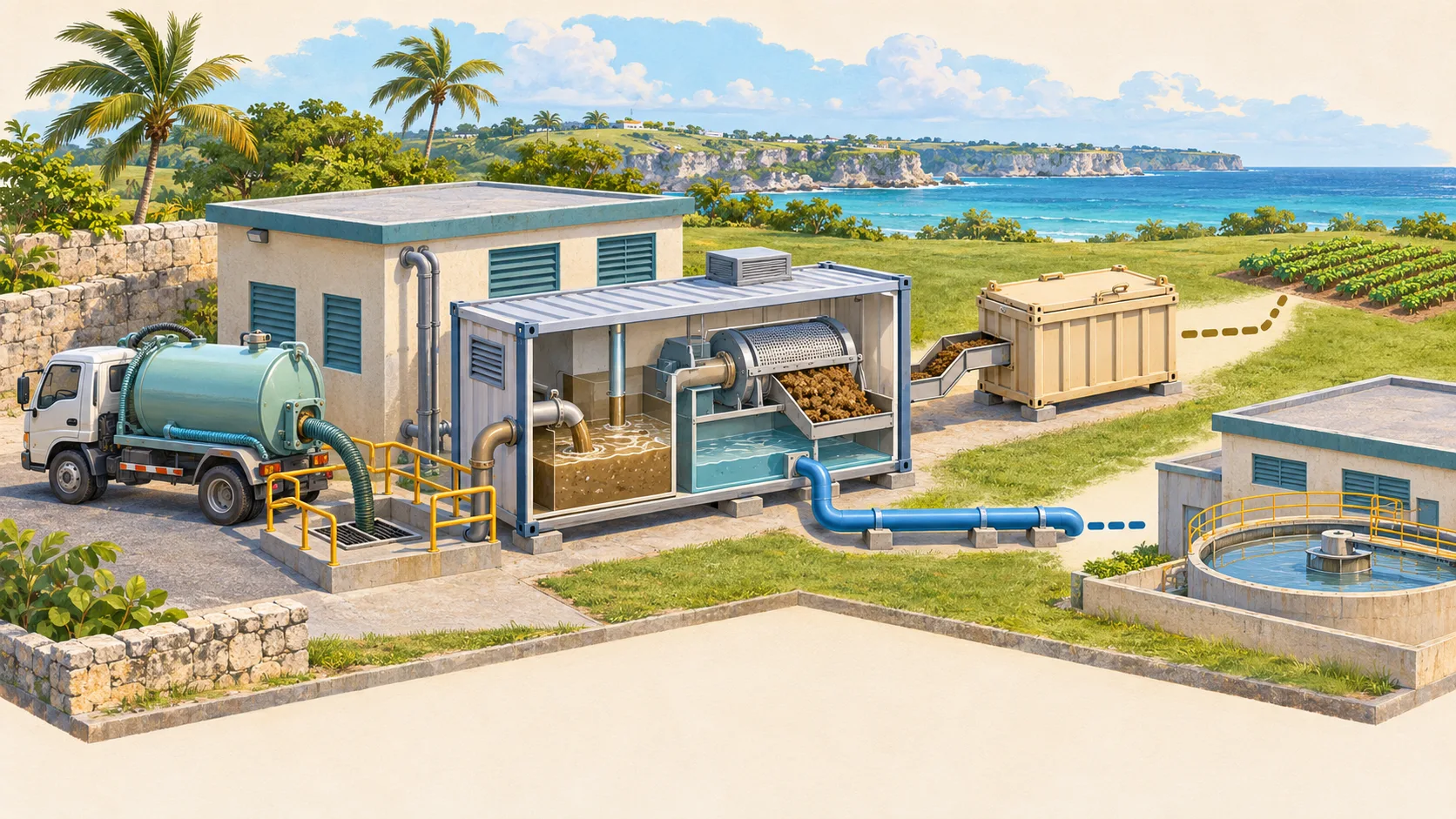
We studied identification of each load, screening, polymer dosing and gravity dewatering. A dewatered solid and a filtrate emerge; optional lime mixing concerns the solid alone. The filtrate still needs treatment or a permitted destination. That dependence changed our sketch of a “self-contained” station into a possible pre-treatment step within a wider service.
To test locally: Variability, throughput, solids capture, polymer and lime consumption, pathogens, contaminants and filtrate quality. A mobile trial or a service at an existing plant may deserve comparison with a fixed installation.
Our first file treated a limed solid as a valuable fertiliser. A later technical review led us to withdraw that claim: lime alone does not establish unrestricted sanitary quality, and most Barbadian soils are already calcareous. American biosolids classes are technical references, not Barbadian permissions.
To be checked: Local health and chemical standards, soil and product analyses, farmers’ needs, storage and a lawful fallback. We have no buyer or spreading area. Our cautious scenario assumes no income from selling the solids.
Our comparison of possible sites compared Lakes Folly, Graeme Hall, Vaucluse and industrial areas. An existing BWA plant could make Lakes Folly relevant to the liquid question, but it is urban and low-lying. Vaucluse has a waste system and more separation from homes, but no established liquid outlet for this idea.
To be checked: Official maps, land, permissions, road times, odour, utilities and coastal risk. These are places to ask about, not sites selected for a project.
Costs, public decisions, local operation and a supplier willing to join the conversation.
We varied assumed volumes, staffing, equipment, reagents, power, freight, transport and charges. The working cases depended heavily on actual loads, any existing low-cost receiving route, imported lime and polymer, and the price of dealing with the liquid. The first model omitted that last cost.
To be checked: Measured volumes and prices, quotations that include installation, trials and authorised outlets. No BWA payment or sale of treated solids is included as an assured income. A haulers’ fee alone did not sustain the mechanised line in our model.
We explored funders, procurement and public-service models. Our research suggested that Barbados fell outside the Danish concessional infrastructure programme we examined. We also found local ownership conditions attached to the reduced company tax rate we considered. Both sets of eligibility rules would need confirming before drawing up a budget. The World Bank target does not commit funds to a station.
To be checked: Whether anyone wants a service, who would procure it, under what rules and with what budget. Funding routes in principle are not commitments, and the island’s institutions would define any need and process.
We once sketched ourselves inside the operating company. Within a week we set that aside. If anything were ever built, its operating team would be Barbadian and trained for the equipment and service. A good outcome would keep working without us.
Guillaume brings field operations, fleet and maintenance experience; Céline brings organisation, programme, logistics and systems experience. We might research, connect, coordinate and help hand over if invited. Roles, jobs and an operator cannot be promised from France.
Cost reference: The manufacturer supplied an indicative equipment offer for a French operator. Its scope and prices would need to be reviewed for a Barbadian setting.
To be checked: Trials on local septage, the filtrate-treatment partner and its results, sanitary evidence, training, maintenance and spare parts. Other makers and methods should be compared against the island’s needs.
BWA · Bridgetown assessment (septage reception, table 1, PDF p. 15) · BWA · Bridgetown upgrade tender · GCF · 3R-CReWS · BWA · South Coast revised assessment (plant sludge, PDF pp. 34–37) · IDB · South Coast project.
World Bank · programme announcement · World Bank · environmental and social systems report (septage, PDF p. 12) · Parliament · 2020 Green Paper (septic tank, PDF p. 22) · Official Gazette · Water Protection Zones Order, 2024 (S.I. No. 27) (Zone D and exemptions).
Barbados Solid Waste Programme · SBRC · EPD · waste management · Simon Moos · dewatering equipment. Manufacturer information is a starting point for tests, not evidence of performance on Barbadian material.
Local knowledge and priorities come first. If this question is useful to those already working on it, we would be glad to compare notes.